This text is not in eCFR or DITA. It is extracted from the Revolutionary FAR Overhaul deviation guide for FAR Part 25. The parsed text is a convenience layer; the Source PDF tab is authoritative. Always verify against the official deviation PDF.
BALANCE OF PAYMENTS PROGRAM—CONSTRUCTION MATERIAL UNDER TRADE AGREEMENTS—BASIC (FEB 2024)
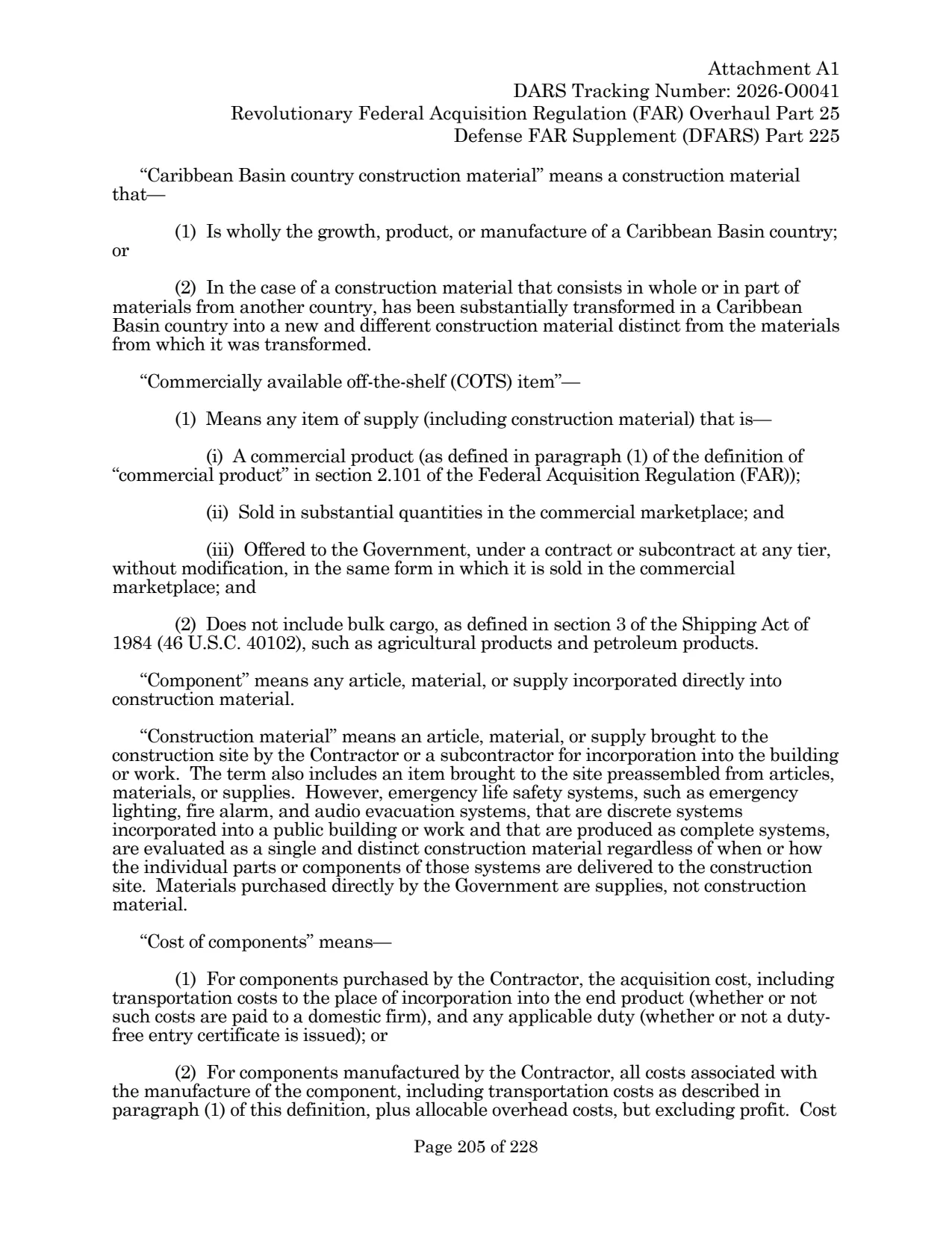
- (a) Definitions. As used in this clause— “Caribbean Basin country construction material” means a construction material that—
- (1) Is wholly the growth, product, or manufacture of a Caribbean Basin country; or
- (2) In the case of a construction material that consists in whole or in part of materials from another country, has been substantially transformed in a Caribbean Basin country into a new and different construction material distinct from the materials from which it was transformed. “Commercially available off-the-shelf (COTS) item”—
- (1) Means any item of supply (including construction material) that is—
- (i) A commercial product (as defined in paragraph (1) of the definition of “commercial product” in section 2.101 of the Federal Acquisition Regulation (FAR));
- (ii) Sold in substantial quantities in the commercial marketplace; and
- (iii) Offered to the Government, under a contract or subcontract at any tier, without modification, in the same form in which it is sold in the commercial marketplace; and
- (2) Does not include bulk cargo, as defined in section 3 of the Shipping Act of 1984 (46 U.S.C. 40102), such as agricultural products and petroleum products. “Component” means any article, material, or supply incorporated directly into construction material. “Construction material” means an article, material, or supply brought to the construction site by the Contractor or a subcontractor for incorporation into the building or work. The term also includes an item brought to the site preassembled from articles, materials, or supplies. However, emergency life safety systems, such as emergency lighting, fire alarm, and audio evacuation systems, that are discrete systems incorporated into a public building or work and that are produced as complete systems, are evaluated as a single and distinct construction material regardless of when or how the individual parts or components of those systems are delivered to the construction site. Materials purchased directly by the Government are supplies, not construction material. “Cost of components” means—
- (1) For components purchased by the Contractor, the acquisition cost, including transportation costs to the place of incorporation into the end product (whether or not such costs are paid to a domestic firm), and any applicable duty (whether or not a dutyfree entry certificate is issued); or
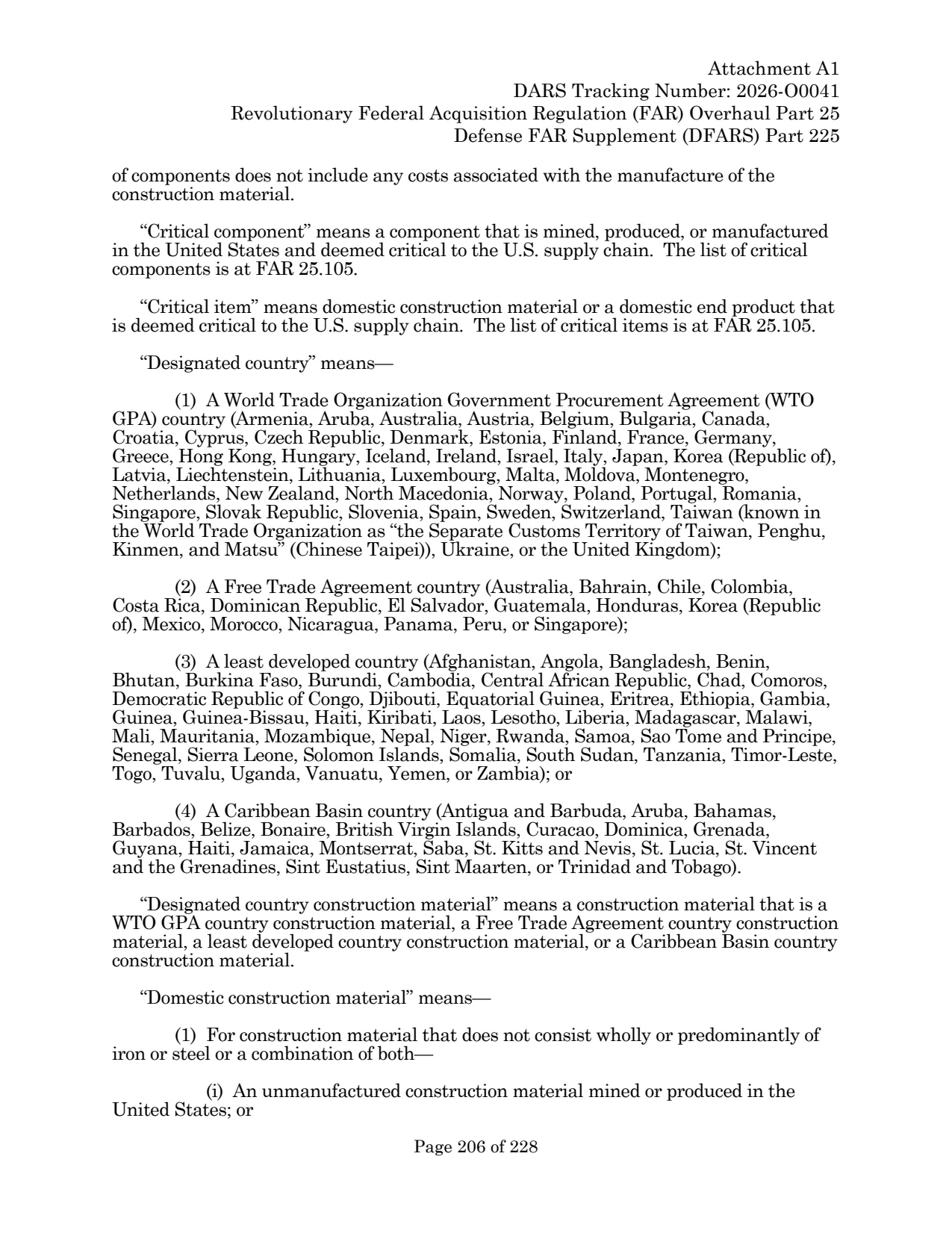
- (2) For components manufactured by the Contractor, all costs associated with the manufacture of the component, including transportation costs as described in paragraph (1) of this definition, plus allocable overhead costs, but excluding profit. Cost of components does not include any costs associated with the manufacture of the construction material. “Critical component” means a component that is mined, produced, or manufactured in the United States and deemed critical to the U.S. supply chain. The list of critical components is at FAR 25.105. “Critical item” means domestic construction material or a domestic end product that is deemed critical to the U.S. supply chain. The list of critical items is at FAR 25.105. “Designated country” means—
- (1) A World Trade Organization Government Procurement Agreement (WTO GPA) country (Armenia, Aruba, Australia, Austria, Belgium, Bulgaria, Canada, Croatia, Cyprus, Czech Republic, Denmark, Estonia, Finland, France, Germany, Greece, Hong Kong, Hungary, Iceland, Ireland, Israel, Italy, Japan, Korea (Republic of), Latvia, Liechtenstein, Lithuania, Luxembourg, Malta, Moldova, Montenegro, Netherlands, New Zealand, North Macedonia, Norway, Poland, Portugal, Romania, Singapore, Slovak Republic, Slovenia, Spain, Sweden, Switzerland, Taiwan (known in the World Trade Organization as “the Separate Customs Territory of Taiwan, Penghu, Kinmen, and Matsu” (Chinese Taipei)), Ukraine, or the United Kingdom);
- (2) A Free Trade Agreement country (Australia, Bahrain, Chile, Colombia, Costa Rica, Dominican Republic, El Salvador, Guatemala, Honduras, Korea (Republic of), Mexico, Morocco, Nicaragua, Panama, Peru, or Singapore);
- (3) A least developed country (Afghanistan, Angola, Bangladesh, Benin, Bhutan, Burkina Faso, Burundi, Cambodia, Central African Republic, Chad, Comoros, Democratic Republic of Congo, Djibouti, Equatorial Guinea, Eritrea, Ethiopia, Gambia, Guinea, Guinea-Bissau, Haiti, Kiribati, Laos, Lesotho, Liberia, Madagascar, Malawi, Mali, Mauritania, Mozambique, Nepal, Niger, Rwanda, Samoa, Sao Tome and Principe, Senegal, Sierra Leone, Solomon Islands, Somalia, South Sudan, Tanzania, Timor-Leste, Togo, Tuvalu, Uganda, Vanuatu, Yemen, or Zambia); or
- (4) A Caribbean Basin country (Antigua and Barbuda, Aruba, Bahamas, Barbados, Belize, Bonaire, British Virgin Islands, Curacao, Dominica, Grenada, Guyana, Haiti, Jamaica, Montserrat, Saba, St. Kitts and Nevis, St. Lucia, St. Vincent and the Grenadines, Sint Eustatius, Sint Maarten, or Trinidad and Tobago). “Designated country construction material” means a construction material that is a WTO GPA country construction material, a Free Trade Agreement country construction material, a least developed country construction material, or a Caribbean Basin country construction material. “Domestic construction material” means—
- (1) For construction material that does not consist wholly or predominantly of iron or steel or a combination of both—
- (i) An unmanufactured construction material mined or produced in the United States; or
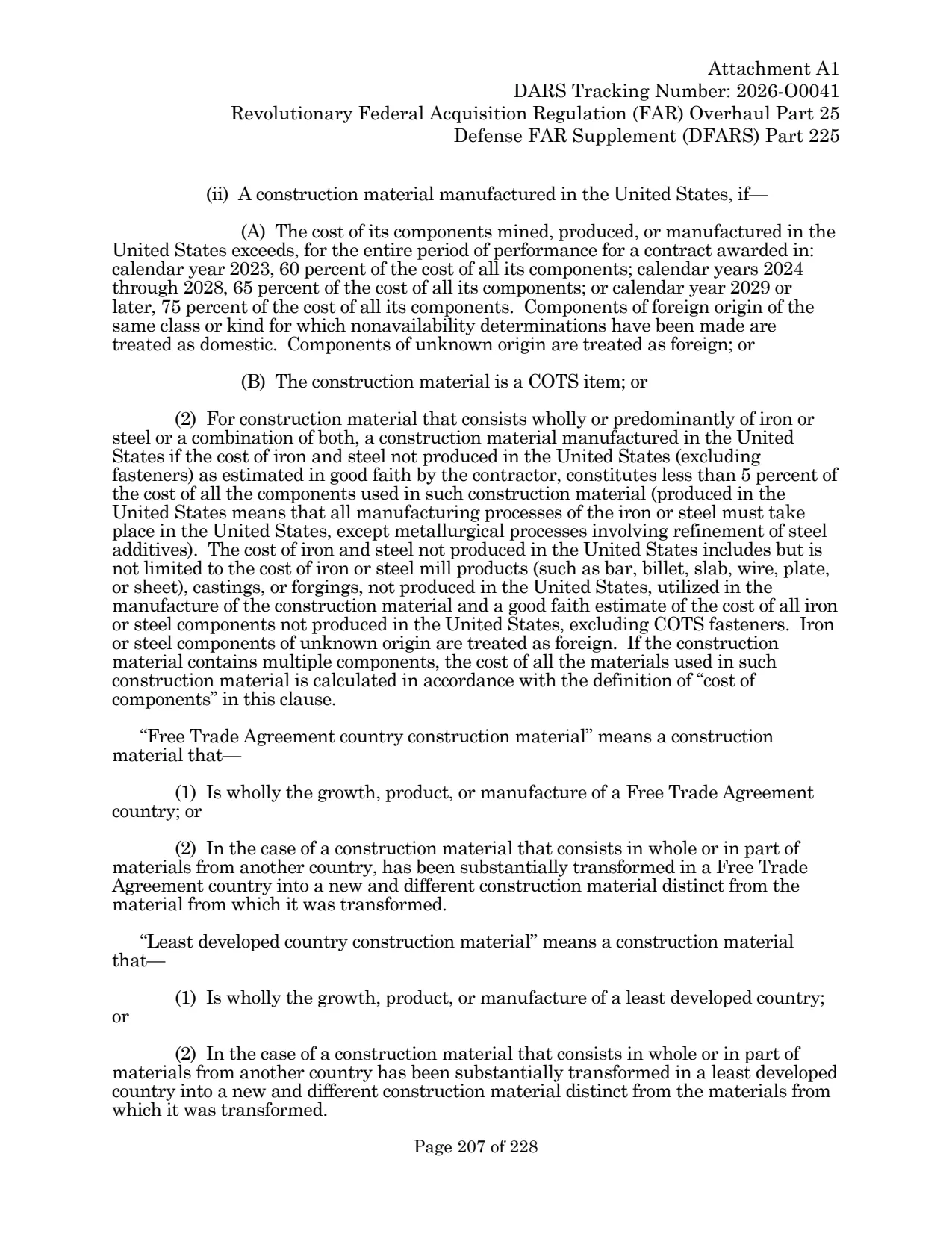
- (ii) A construction material manufactured in the United States, if—
- (A) The cost of its components mined, produced, or manufactured in the United States exceeds 60 percent of the cost of all its components, except that the percentage will be 65 percent for items delivered in calendar years 2024 through 2028 and 75 percent for items delivered starting in calendar year 2029, unless an alternate percentage is established for a contract in accordance with FAR 25.201(c). Components of foreign origin of the same class or kind for which nonavailability determinations have been made are treated as domestic. Components of unknown origin are treated as foreign; or
- (B) The construction material is a COTS item; or
- (2) For construction material that consists wholly or predominantly of iron or steel or a combination of both, a construction material manufactured in the United States if the cost of iron and steel not produced in the United States (excluding fasteners) as estimated in good faith by the contractor, constitutes less than 5 percent of the cost of all the components used in such construction material (produced in the United States means that all manufacturing processes of the iron or steel must take place in the United States, except metallurgical processes involving refinement of steel additives). The cost of iron and steel not produced in the United States includes but is not limited to the cost of iron or steel mill products (such as bar, billet, slab, wire, plate, or sheet), castings, or forgings, not produced in the United States, utilized in the manufacture of the construction material and a good faith estimate of the cost of all iron or steel components not produced in the United States, excluding COTS fasteners. Iron or steel components of unknown origin are treated as foreign. If the construction material contains multiple components, the cost of all the materials used in such construction material is calculated in accordance with the definition of “cost of components” in this clause. “Free Trade Agreement country construction material” means a construction material that—
- (1) Is wholly the growth, product, or manufacture of a Free Trade Agreement country; or
- (2) In the case of a construction material that consists in whole or in part of materials from another country, has been substantially transformed in a Free Trade Agreement country into a new and different construction material distinct from the material from which it was transformed. “Least developed country construction material” means a construction material that—
- (1) Is wholly the growth, product, or manufacture of a least developed country; or
- (2) In the case of a construction material that consists in whole or in part of materials from another country, has been substantially transformed in a least developed country into a new and different construction material distinct from the materials from which it was transformed. “Predominantly of iron or steel or a combination of both” means that the cost of the iron and steel content exceeds 50 percent of the total cost of all its components. The cost of iron and steel is the cost of the iron or steel mill products (such as bar, billet, slab, wire, plate, or sheet), castings, or forgings utilized in the manufacture of the product and a good faith estimate of the cost of iron or steel components excluding COTS fasteners. “Steel” means an alloy that includes at least 50 percent iron, between 0.02 and 2 percent carbon, and may include other elements. “United States” means the 50 States, the District of Columbia, and outlying areas. “WTO GPA country construction material” means a construction material that—
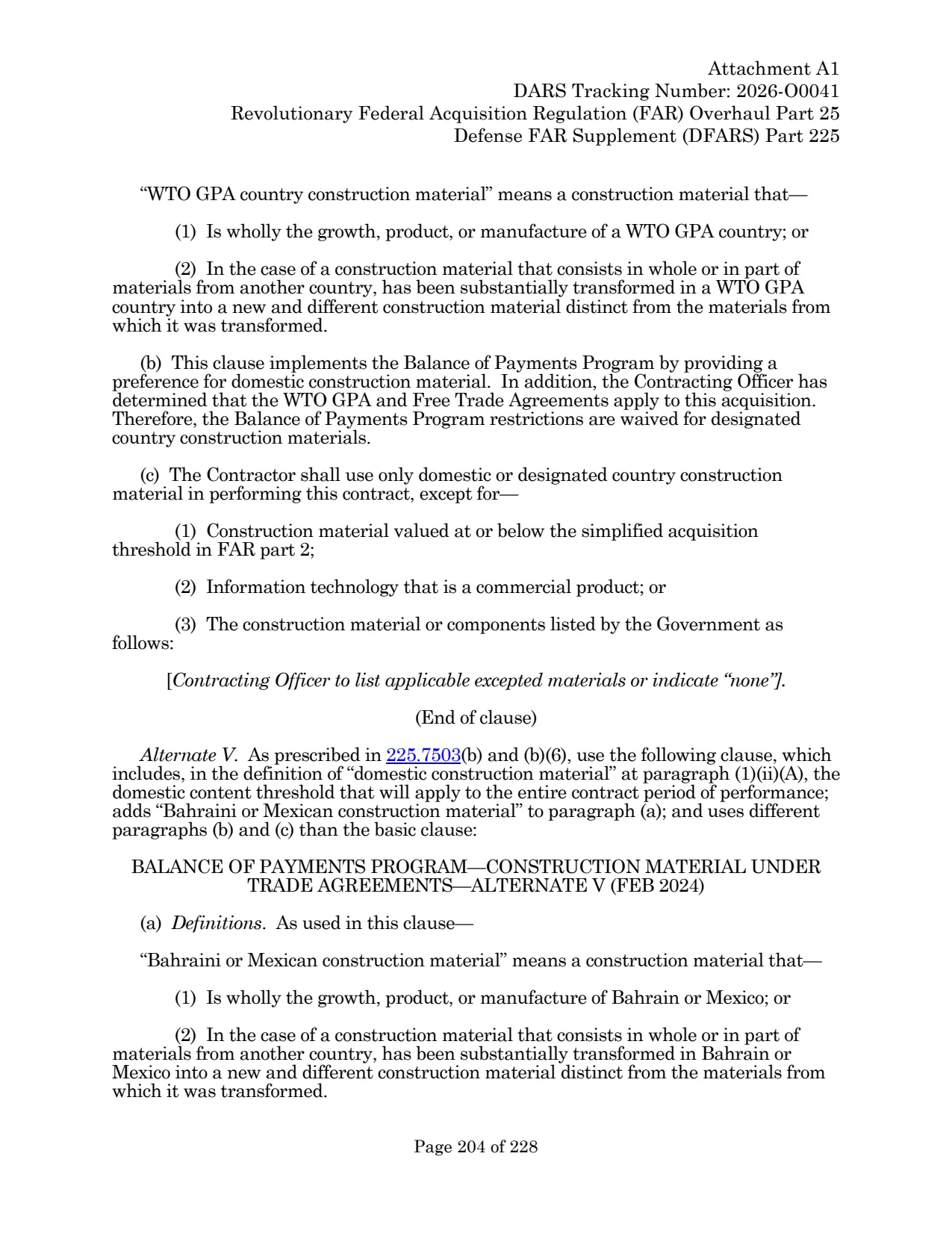
- (1) Is wholly the growth, product, or manufacture of a WTO GPA country; or
- (2) In the case of a construction material that consists in whole or in part of materials from another country, has been substantially transformed in a WTO GPA country into a new and different construction material distinct from the materials from which it was transformed.
- (1) For construction material that does not consist wholly or predominantly of iron or steel or a combination of both—
- (1) Means any item of supply (including construction material) that is—
- (b) This clause implements the Balance of Payments Program by providing a preference for domestic construction material. In addition, the Contracting Officer has determined that the WTO GPA and Free Trade Agreements apply to this acquisition. Therefore, the Balance of Payments Program restrictions are waived for designated country construction materials.
- (c) The Contractor shall use only domestic or designated country construction material in performing this contract, except for—
- (1) Construction material valued at or below the simplified acquisition threshold in part 2 of the Federal Acquisition Regulation;
- (2) Information technology that is a commercial product; or
- (3) The construction material or components listed by the Government as follows: ___________________________________________________________________________ [Contracting Officer to list applicable excepted materials or indicate “none”] Alternate I. As prescribed in 225.7503(b) and (b)(2), use the following clause, which adds “Bahraini or Mexican construction material” to paragraph (a), and uses a different paragraph (b) and (c) than the basic clause: BALANCE OF PAYMENTS PROGRAM—CONSTRUCTION MATERIAL UNDER TRADE AGREEMENTS—ALTERNATE I (FEB 2024)
- (a) Definitions. As used in this clause— “Bahraini or Mexican construction material” means a construction material that—
- (1) Is wholly the growth, product, or manufacture of Bahrain or Mexico; or
- (2) In the case of a construction material that consists in whole or in part of materials from another country, has been substantially transformed in Bahrain or Mexico into a new and different construction material distinct from the materials from which it was transformed. “Caribbean Basin country construction material” means a construction material that—
- (1) Is wholly the growth, product, or manufacture of a Caribbean Basin country; or
- (2) In the case of a construction material that consists in whole or in part of materials from another country, has been substantially transformed in a Caribbean Basin country into a new and different construction material distinct from the materials from which it was transformed. “Commercially available off-the-shelf (COTS) item”—
- (1) Means any item of supply (including construction material) that is—
- (i) A commercial product (as defined in paragraph (1) of the definition of “commercial product” in section 2.101 of the Federal Acquisition Regulation (FAR));
- (ii) Sold in substantial quantities in the commercial marketplace; and
- (iii) Offered to the Government, under a contract or subcontract at any tier, without modification, in the same form in which it is sold in the commercial marketplace; and
- (2) Does not include bulk cargo, as defined in section 3 of the Shipping Act of 1984 (46 U.S.C. 40102), such as agricultural products and petroleum products. “Component” means any article, material, or supply incorporated directly into construction material. “Construction material” means an article, material, or supply brought to the construction site by the Contractor or a subcontractor for incorporation into the building or work. The term also includes an item brought to the site preassembled from articles, materials, or supplies. However, emergency life safety systems, such as emergency lighting, fire alarm, and audio evacuation systems, that are discrete systems incorporated into a public building or work and that are produced as complete systems, are evaluated as a single and distinct construction material regardless of when or how the individual parts or components of those systems are delivered to the construction site. Materials purchased directly by the Government are supplies, not construction material. “Cost of components” means—
- (1) For components purchased by the Contractor, the acquisition cost, including transportation costs to the place of incorporation into the end product (whether or not such costs are paid to a domestic firm), and any applicable duty (whether or not a dutyfree entry certificate is issued); or
- (2) For components manufactured by the Contractor, all costs associated with the manufacture of the component, including transportation costs as described in paragraph (1) of this definition, plus allocable overhead costs, but excluding profit. Cost of components does not include any costs associated with the manufacture of the construction material. “Critical component” means a component that is mined, produced, or manufactured in the United States and deemed critical to the U.S. supply chain. The list of critical components is at FAR 25.105. “Critical item” means domestic construction material or a domestic end product that is deemed critical to the U.S. supply chain. The list of critical items is at FAR 25.105. “Designated country” means—
- (1) A World Trade Organization Government Procurement Agreement (WTO GPA) country (Armenia, Aruba, Australia, Austria, Belgium, Bulgaria, Canada, Croatia, Cyprus, Czech Republic, Denmark, Estonia, Finland, France, Germany, Greece, Hong Kong, Hungary, Iceland, Ireland, Israel, Italy, Japan, Korea (Republic of), Latvia, Liechtenstein, Lithuania, Luxembourg, Malta, Moldova, Montenegro, Netherlands, New Zealand, North Macedonia, Norway, Poland, Portugal, Romania, Singapore, Slovak Republic, Slovenia, Spain, Sweden, Switzerland, Taiwan (known in the World Trade Organization as “the Separate Customs Territory of Taiwan, Penghu, Kinmen, and Matsu” (Chinese Taipei)), Ukraine, or the United Kingdom);
- (2) A Free Trade Agreement country (Australia, Bahrain, Chile, Colombia, Costa Rica, Dominican Republic, El Salvador, Guatemala, Honduras, Korea (Republic of), Mexico, Morocco, Nicaragua, Panama, Peru, or Singapore);
- (3) A least developed country (Afghanistan, Angola, Bangladesh, Benin, Bhutan, Burkina Faso, Burundi, Cambodia, Central African Republic, Chad, Comoros, Democratic Republic of Congo, Djibouti, Equatorial Guinea, Eritrea, Ethiopia, Gambia, Guinea, Guinea-Bissau, Haiti, Kiribati, Laos, Lesotho, Liberia, Madagascar, Malawi, Mali, Mauritania, Mozambique, Nepal, Niger, Rwanda, Samoa, Sao Tome and Principe, Senegal, Sierra Leone, Solomon Islands, Somalia, South Sudan, Tanzania, Timor-Leste, Togo, Tuvalu, Uganda, Vanuatu, Yemen, or Zambia); or
- (4) A Caribbean Basin country (Antigua and Barbuda, Aruba, Bahamas, Barbados, Belize, Bonaire, British Virgin Islands, Curacao, Dominica, Grenada, Guyana, Haiti, Jamaica, Montserrat, Saba, St. Kitts and Nevis, St. Lucia, St. Vincent and the Grenadines, Sint Eustatius, Sint Maarten, or Trinidad and Tobago). “Designated country construction material” means a construction material that is a WTO GPA country construction material, a Free Trade Agreement country construction material, a least developed country construction material, or a Caribbean Basin country construction material. “Domestic construction material” means—
- (1) For construction material that does not consist wholly or predominantly of iron or steel or a combination of both—
- (i) An unmanufactured construction material mined or produced in the United States; or
- (ii) A construction material manufactured in the United States, if—
- (A) The cost of its components mined, produced, or manufactured in the United States exceeds 60 percent of the cost of all its components, except that the percentage will be 65 percent for items delivered in calendar years 2024 through 2028 and 75 percent for items delivered starting in calendar year 2029, unless an alternate percentage is established for a contract in accordance with FAR 25.201(c). Components of foreign origin of the same class or kind for which nonavailability determinations have been made are treated as domestic. Components of unknown origin are treated as foreign; or
- (B) The construction material is a COTS item; or
- (2) For construction material that consists wholly or predominantly of iron or steel or a combination of both, a construction material manufactured in the United States if the cost of iron and steel not produced in the United States (excluding fasteners) as estimated in good faith by the contractor, constitutes less than 5 percent of the cost of all the components used in such construction material (produced in the United States means that all manufacturing processes of the iron or steel must take place in the United States, except metallurgical processes involving refinement of steel additives). The cost of iron and steel not produced in the United States includes but is not limited to the cost of iron or steel mill products (such as bar, billet, slab, wire, plate, or sheet), castings, or forgings, not produced in the United States, utilized in the manufacture of the construction material and a good faith estimate of the cost of all iron or steel components not produced in the United States, excluding COTS fasteners. Iron or steel components of unknown origin are treated as foreign. If the construction material contains multiple components, the cost of all the materials used in such construction material is calculated in accordance with the definition of “cost of components” in this clause. “Free Trade Agreement country construction material” means a construction material that—
- (1) Is wholly the growth, product, or manufacture of a Free Trade Agreement country; or
- (2) In the case of a construction material that consists in whole or in part of materials from another country, has been substantially transformed in a Free Trade Agreement country into a new and different construction material distinct from the material from which it was transformed. “Least developed country construction material” means a construction material that—
- (1) Is wholly the growth, product, or manufacture of a least developed country; or
- (2) In the case of a construction material that consists in whole or in part of materials from another country, has been substantially transformed in a least developed country into a new and different construction material distinct from the materials from which it was transformed. “Predominantly of iron or steel or a combination of both” means that the cost of the iron and steel content exceeds 50 percent of the total cost of all its components. The cost of iron and steel is the cost of the iron or steel mill products (such as bar, billet, slab, wire, plate, or sheet), castings, or forgings utilized in the manufacture of the product and a good faith estimate of the cost of iron or steel components excluding COTS fasteners. “Steel” means an alloy that includes at least 50 percent iron, between 0.02 and 2 percent carbon, and may include other elements. “United States” means the 50 States, the District of Columbia, and outlying areas. “WTO GPA country construction material” means a construction material that—
- (1) Is wholly the growth, product, or manufacture of a WTO GPA country; or
- (2) In the case of a construction material that consists in whole or in part of materials from another country, has been substantially transformed in a WTO GPA country into a new and different construction material distinct from the materials from which it was transformed.
- (1) For construction material that does not consist wholly or predominantly of iron or steel or a combination of both—
- (1) Means any item of supply (including construction material) that is—
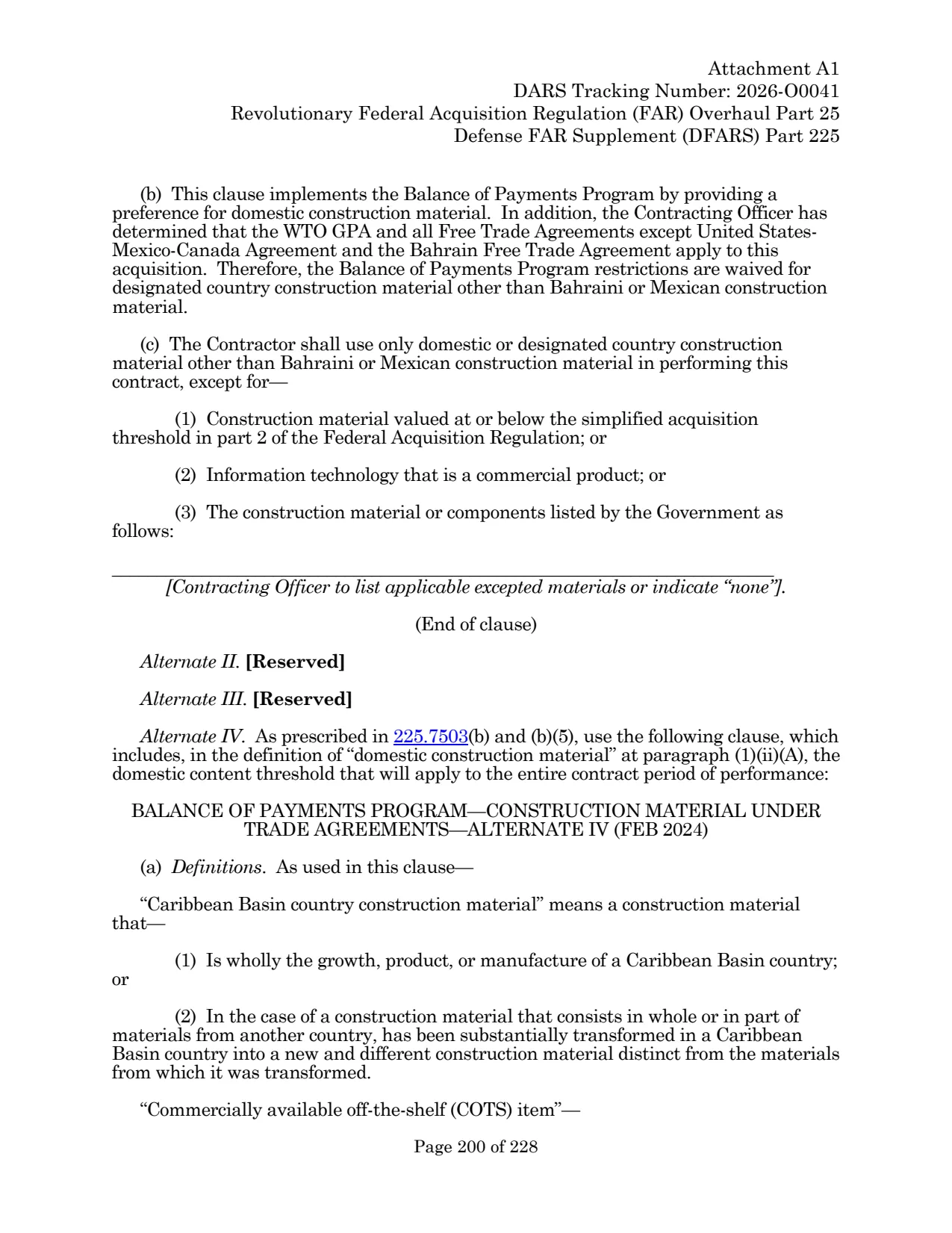
- (b) This clause implements the Balance of Payments Program by providing a preference for domestic construction material. In addition, the Contracting Officer has determined that the WTO GPA and all Free Trade Agreements except United StatesMexico-Canada Agreement and the Bahrain Free Trade Agreement apply to this acquisition. Therefore, the Balance of Payments Program restrictions are waived for designated country construction material other than Bahraini or Mexican construction material.
- (c) The Contractor shall use only domestic or designated country construction material other than Bahraini or Mexican construction material in performing this contract, except for—
- (1) Construction material valued at or below the simplified acquisition threshold in part 2 of the Federal Acquisition Regulation; or
- (2) Information technology that is a commercial product; or
- (3) The construction material or components listed by the Government as follows: __________________________________________________________________________ [Contracting Officer to list applicable excepted materials or indicate “none”]. Alternate II. [Reserved] Alternate III. [Reserved] Alternate IV. As prescribed in 225.7503(b) and (b)(5), use the following clause, which includes, in the definition of “domestic construction material” at paragraph (1)(ii)(A), the domestic content threshold that will apply to the entire contract period of performance: BALANCE OF PAYMENTS PROGRAM—CONSTRUCTION MATERIAL UNDER TRADE AGREEMENTS—ALTERNATE IV (FEB 2024)
- (a) Definitions. As used in this clause— “Caribbean Basin country construction material” means a construction material that—
- (1) Is wholly the growth, product, or manufacture of a Caribbean Basin country; or
- (2) In the case of a construction material that consists in whole or in part of materials from another country, has been substantially transformed in a Caribbean Basin country into a new and different construction material distinct from the materials from which it was transformed. “Commercially available off-the-shelf (COTS) item”—
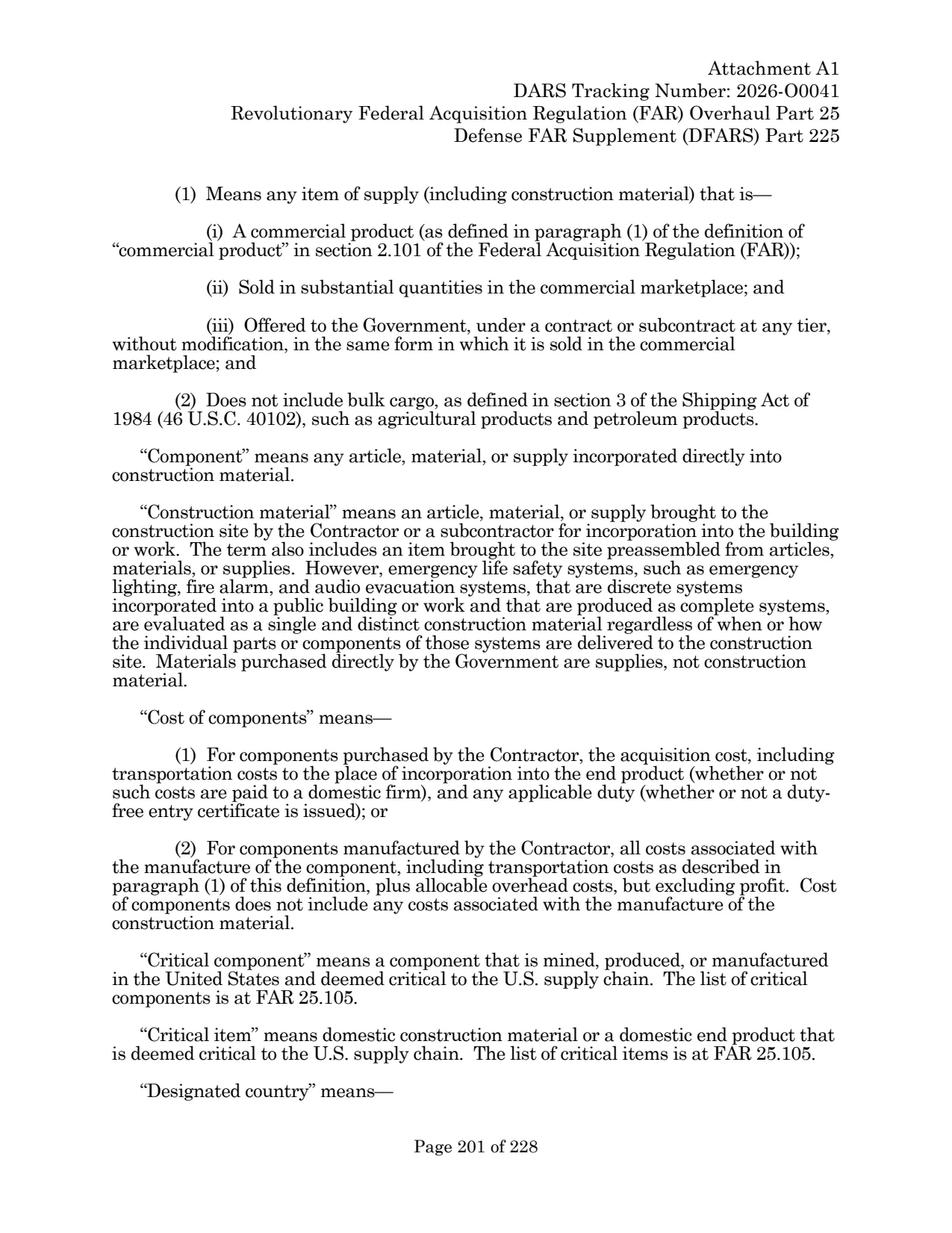
- (1) Means any item of supply (including construction material) that is—
- (i) A commercial product (as defined in paragraph (1) of the definition of “commercial product” in section 2.101 of the Federal Acquisition Regulation (FAR));
- (ii) Sold in substantial quantities in the commercial marketplace; and
- (iii) Offered to the Government, under a contract or subcontract at any tier, without modification, in the same form in which it is sold in the commercial marketplace; and
- (2) Does not include bulk cargo, as defined in section 3 of the Shipping Act of 1984 (46 U.S.C. 40102), such as agricultural products and petroleum products. “Component” means any article, material, or supply incorporated directly into construction material. “Construction material” means an article, material, or supply brought to the construction site by the Contractor or a subcontractor for incorporation into the building or work. The term also includes an item brought to the site preassembled from articles, materials, or supplies. However, emergency life safety systems, such as emergency lighting, fire alarm, and audio evacuation systems, that are discrete systems incorporated into a public building or work and that are produced as complete systems, are evaluated as a single and distinct construction material regardless of when or how the individual parts or components of those systems are delivered to the construction site. Materials purchased directly by the Government are supplies, not construction material. “Cost of components” means—
- (1) For components purchased by the Contractor, the acquisition cost, including transportation costs to the place of incorporation into the end product (whether or not such costs are paid to a domestic firm), and any applicable duty (whether or not a dutyfree entry certificate is issued); or
- (2) For components manufactured by the Contractor, all costs associated with the manufacture of the component, including transportation costs as described in paragraph (1) of this definition, plus allocable overhead costs, but excluding profit. Cost of components does not include any costs associated with the manufacture of the construction material. “Critical component” means a component that is mined, produced, or manufactured in the United States and deemed critical to the U.S. supply chain. The list of critical components is at FAR 25.105. “Critical item” means domestic construction material or a domestic end product that is deemed critical to the U.S. supply chain. The list of critical items is at FAR 25.105. “Designated country” means—
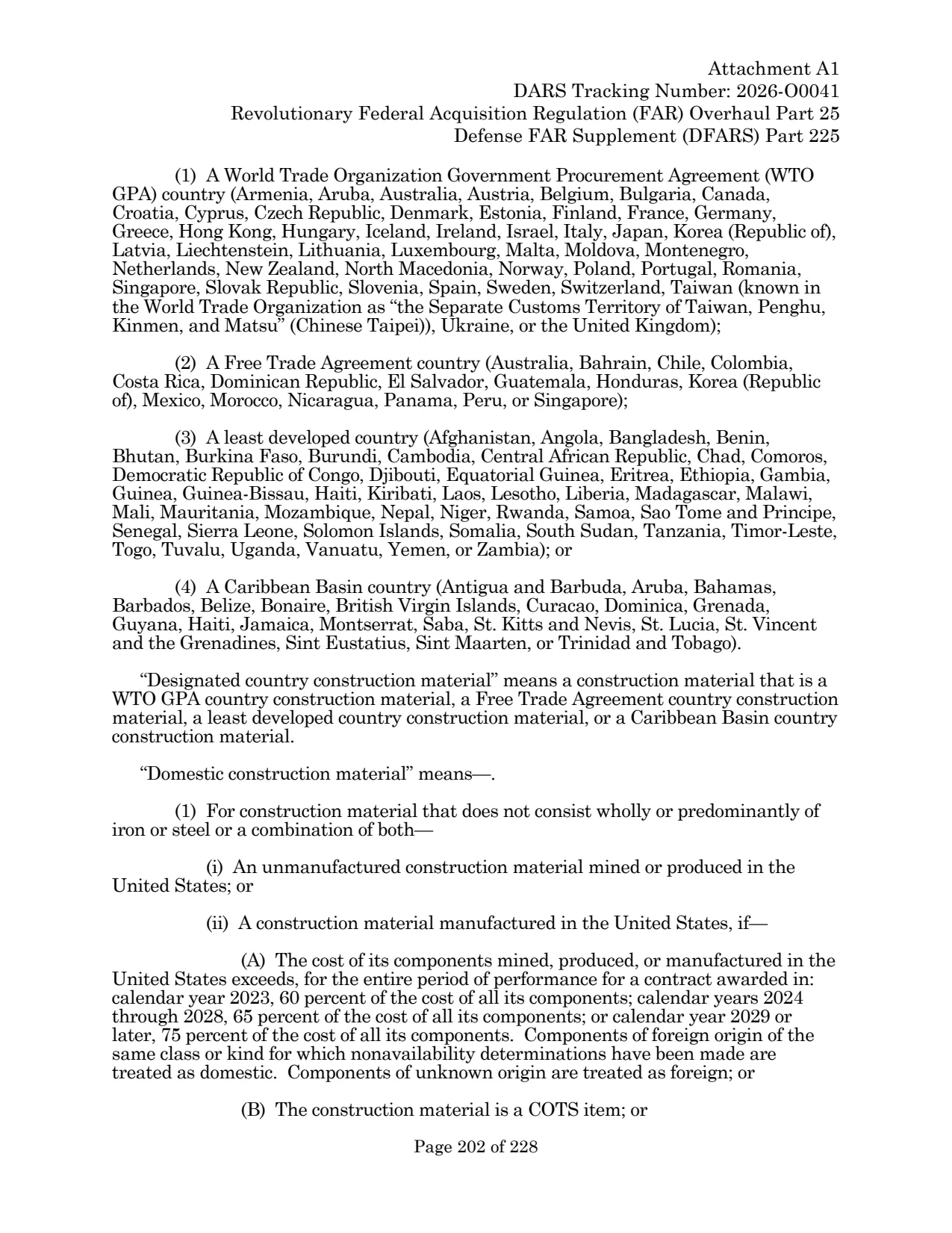
- (1) A World Trade Organization Government Procurement Agreement (WTO GPA) country (Armenia, Aruba, Australia, Austria, Belgium, Bulgaria, Canada, Croatia, Cyprus, Czech Republic, Denmark, Estonia, Finland, France, Germany, Greece, Hong Kong, Hungary, Iceland, Ireland, Israel, Italy, Japan, Korea (Republic of), Latvia, Liechtenstein, Lithuania, Luxembourg, Malta, Moldova, Montenegro, Netherlands, New Zealand, North Macedonia, Norway, Poland, Portugal, Romania, Singapore, Slovak Republic, Slovenia, Spain, Sweden, Switzerland, Taiwan (known in the World Trade Organization as “the Separate Customs Territory of Taiwan, Penghu, Kinmen, and Matsu” (Chinese Taipei)), Ukraine, or the United Kingdom);
- (2) A Free Trade Agreement country (Australia, Bahrain, Chile, Colombia, Costa Rica, Dominican Republic, El Salvador, Guatemala, Honduras, Korea (Republic of), Mexico, Morocco, Nicaragua, Panama, Peru, or Singapore);
- (3) A least developed country (Afghanistan, Angola, Bangladesh, Benin, Bhutan, Burkina Faso, Burundi, Cambodia, Central African Republic, Chad, Comoros, Democratic Republic of Congo, Djibouti, Equatorial Guinea, Eritrea, Ethiopia, Gambia, Guinea, Guinea-Bissau, Haiti, Kiribati, Laos, Lesotho, Liberia, Madagascar, Malawi, Mali, Mauritania, Mozambique, Nepal, Niger, Rwanda, Samoa, Sao Tome and Principe, Senegal, Sierra Leone, Solomon Islands, Somalia, South Sudan, Tanzania, Timor-Leste, Togo, Tuvalu, Uganda, Vanuatu, Yemen, or Zambia); or
- (4) A Caribbean Basin country (Antigua and Barbuda, Aruba, Bahamas, Barbados, Belize, Bonaire, British Virgin Islands, Curacao, Dominica, Grenada, Guyana, Haiti, Jamaica, Montserrat, Saba, St. Kitts and Nevis, St. Lucia, St. Vincent and the Grenadines, Sint Eustatius, Sint Maarten, or Trinidad and Tobago). “Designated country construction material” means a construction material that is a WTO GPA country construction material, a Free Trade Agreement country construction material, a least developed country construction material, or a Caribbean Basin country construction material. “Domestic construction material” means—.
- (1) For construction material that does not consist wholly or predominantly of iron or steel or a combination of both—
- (i) An unmanufactured construction material mined or produced in the United States; or
- (ii) A construction material manufactured in the United States, if—
- (A) The cost of its components mined, produced, or manufactured in the United States exceeds, for the entire period of performance for a contract awarded in: calendar year 2023, 60 percent of the cost of all its components; calendar years 2024 through 2028, 65 percent of the cost of all its components; or calendar year 2029 or later, 75 percent of the cost of all its components. Components of foreign origin of the same class or kind for which nonavailability determinations have been made are treated as domestic. Components of unknown origin are treated as foreign; or
- (B) The construction material is a COTS item; or
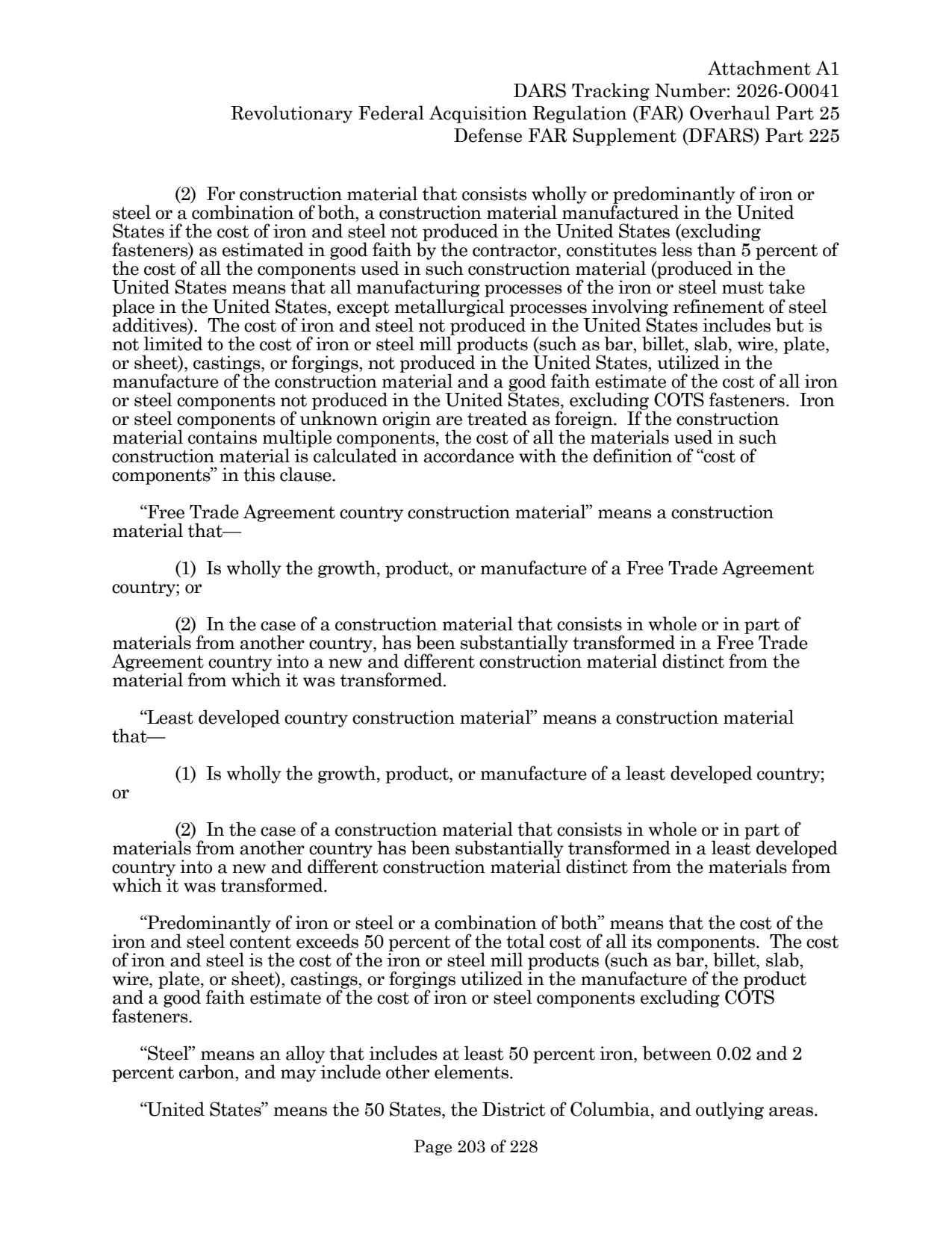
- (2) For construction material that consists wholly or predominantly of iron or steel or a combination of both, a construction material manufactured in the United States if the cost of iron and steel not produced in the United States (excluding fasteners) as estimated in good faith by the contractor, constitutes less than 5 percent of the cost of all the components used in such construction material (produced in the United States means that all manufacturing processes of the iron or steel must take place in the United States, except metallurgical processes involving refinement of steel additives). The cost of iron and steel not produced in the United States includes but is not limited to the cost of iron or steel mill products (such as bar, billet, slab, wire, plate, or sheet), castings, or forgings, not produced in the United States, utilized in the manufacture of the construction material and a good faith estimate of the cost of all iron or steel components not produced in the United States, excluding COTS fasteners. Iron or steel components of unknown origin are treated as foreign. If the construction material contains multiple components, the cost of all the materials used in such construction material is calculated in accordance with the definition of “cost of components” in this clause. “Free Trade Agreement country construction material” means a construction material that—
- (1) Is wholly the growth, product, or manufacture of a Free Trade Agreement country; or
- (2) In the case of a construction material that consists in whole or in part of materials from another country, has been substantially transformed in a Free Trade Agreement country into a new and different construction material distinct from the material from which it was transformed. “Least developed country construction material” means a construction material that—
- (1) Is wholly the growth, product, or manufacture of a least developed country; or
- (2) In the case of a construction material that consists in whole or in part of materials from another country has been substantially transformed in a least developed country into a new and different construction material distinct from the materials from which it was transformed. “Predominantly of iron or steel or a combination of both” means that the cost of the iron and steel content exceeds 50 percent of the total cost of all its components. The cost of iron and steel is the cost of the iron or steel mill products (such as bar, billet, slab, wire, plate, or sheet), castings, or forgings utilized in the manufacture of the product and a good faith estimate of the cost of iron or steel components excluding COTS fasteners. “Steel” means an alloy that includes at least 50 percent iron, between 0.02 and 2 percent carbon, and may include other elements. “United States” means the 50 States, the District of Columbia, and outlying areas. “WTO GPA country construction material” means a construction material that—
- (1) Is wholly the growth, product, or manufacture of a WTO GPA country; or
- (2) In the case of a construction material that consists in whole or in part of materials from another country, has been substantially transformed in a WTO GPA country into a new and different construction material distinct from the materials from which it was transformed.
- (1) For construction material that does not consist wholly or predominantly of iron or steel or a combination of both—
- (1) Means any item of supply (including construction material) that is—
- (b) This clause implements the Balance of Payments Program by providing a preference for domestic construction material. In addition, the Contracting Officer has determined that the WTO GPA and Free Trade Agreements apply to this acquisition. Therefore, the Balance of Payments Program restrictions are waived for designated country construction materials.
- (c) The Contractor shall use only domestic or designated country construction material in performing this contract, except for—
- (1) Construction material valued at or below the simplified acquisition threshold in FAR part 2;
- (2) Information technology that is a commercial product; or
- (3) The construction material or components listed by the Government as follows: [Contracting Officer to list applicable excepted materials or indicate “none”]. Alternate V. As prescribed in 225.7503(b) and (b)(6), use the following clause, which includes, in the definition of “domestic construction material” at paragraph (1)(ii)(A), the domestic content threshold that will apply to the entire contract period of performance; adds “Bahraini or Mexican construction material” to paragraph (a); and uses different paragraphs (b) and (c) than the basic clause: BALANCE OF PAYMENTS PROGRAM—CONSTRUCTION MATERIAL UNDER TRADE AGREEMENTS—ALTERNATE V (FEB 2024)
- (a) Definitions. As used in this clause— “Bahraini or Mexican construction material” means a construction material that—
- (1) Is wholly the growth, product, or manufacture of Bahrain or Mexico; or
- (2) In the case of a construction material that consists in whole or in part of materials from another country, has been substantially transformed in Bahrain or Mexico into a new and different construction material distinct from the materials from which it was transformed. “Caribbean Basin country construction material” means a construction material that—
- (1) Is wholly the growth, product, or manufacture of a Caribbean Basin country; or
- (2) In the case of a construction material that consists in whole or in part of materials from another country, has been substantially transformed in a Caribbean Basin country into a new and different construction material distinct from the materials from which it was transformed. “Commercially available off-the-shelf (COTS) item”—
- (1) Means any item of supply (including construction material) that is—
- (i) A commercial product (as defined in paragraph (1) of the definition of “commercial product” in section 2.101 of the Federal Acquisition Regulation (FAR));
- (ii) Sold in substantial quantities in the commercial marketplace; and
- (iii) Offered to the Government, under a contract or subcontract at any tier, without modification, in the same form in which it is sold in the commercial marketplace; and
- (2) Does not include bulk cargo, as defined in section 3 of the Shipping Act of 1984 (46 U.S.C. 40102), such as agricultural products and petroleum products. “Component” means any article, material, or supply incorporated directly into construction material. “Construction material” means an article, material, or supply brought to the construction site by the Contractor or a subcontractor for incorporation into the building or work. The term also includes an item brought to the site preassembled from articles, materials, or supplies. However, emergency life safety systems, such as emergency lighting, fire alarm, and audio evacuation systems, that are discrete systems incorporated into a public building or work and that are produced as complete systems, are evaluated as a single and distinct construction material regardless of when or how the individual parts or components of those systems are delivered to the construction site. Materials purchased directly by the Government are supplies, not construction material. “Cost of components” means—
- (1) For components purchased by the Contractor, the acquisition cost, including transportation costs to the place of incorporation into the end product (whether or not such costs are paid to a domestic firm), and any applicable duty (whether or not a dutyfree entry certificate is issued); or
- (2) For components manufactured by the Contractor, all costs associated with the manufacture of the component, including transportation costs as described in paragraph (1) of this definition, plus allocable overhead costs, but excluding profit. Cost of components does not include any costs associated with the manufacture of the construction material. “Critical component” means a component that is mined, produced, or manufactured in the United States and deemed critical to the U.S. supply chain. The list of critical components is at FAR 25.105. “Critical item” means domestic construction material or a domestic end product that is deemed critical to the U.S. supply chain. The list of critical items is at FAR 25.105. “Designated country” means—
- (1) A World Trade Organization Government Procurement Agreement (WTO GPA) country (Armenia, Aruba, Australia, Austria, Belgium, Bulgaria, Canada, Croatia, Cyprus, Czech Republic, Denmark, Estonia, Finland, France, Germany, Greece, Hong Kong, Hungary, Iceland, Ireland, Israel, Italy, Japan, Korea (Republic of), Latvia, Liechtenstein, Lithuania, Luxembourg, Malta, Moldova, Montenegro, Netherlands, New Zealand, North Macedonia, Norway, Poland, Portugal, Romania, Singapore, Slovak Republic, Slovenia, Spain, Sweden, Switzerland, Taiwan (known in the World Trade Organization as “the Separate Customs Territory of Taiwan, Penghu, Kinmen, and Matsu” (Chinese Taipei)), Ukraine, or the United Kingdom);
- (2) A Free Trade Agreement country (Australia, Bahrain, Chile, Colombia, Costa Rica, Dominican Republic, El Salvador, Guatemala, Honduras, Korea (Republic of), Mexico, Morocco, Nicaragua, Panama, Peru, or Singapore);
- (3) A least developed country (Afghanistan, Angola, Bangladesh, Benin, Bhutan, Burkina Faso, Burundi, Cambodia, Central African Republic, Chad, Comoros, Democratic Republic of Congo, Djibouti, Equatorial Guinea, Eritrea, Ethiopia, Gambia, Guinea, Guinea-Bissau, Haiti, Kiribati, Laos, Lesotho, Liberia, Madagascar, Malawi, Mali, Mauritania, Mozambique, Nepal, Niger, Rwanda, Samoa, Sao Tome and Principe, Senegal, Sierra Leone, Solomon Islands, Somalia, South Sudan, Tanzania, Timor-Leste, Togo, Tuvalu, Uganda, Vanuatu, Yemen, or Zambia); or
- (4) A Caribbean Basin country (Antigua and Barbuda, Aruba, Bahamas, Barbados, Belize, Bonaire, British Virgin Islands, Curacao, Dominica, Grenada, Guyana, Haiti, Jamaica, Montserrat, Saba, St. Kitts and Nevis, St. Lucia, St. Vincent and the Grenadines, Sint Eustatius, Sint Maarten, or Trinidad and Tobago). “Designated country construction material” means a construction material that is a WTO GPA country construction material, a Free Trade Agreement country construction material, a least developed country construction material, or a Caribbean Basin country construction material. “Domestic construction material” means—
- (1) For construction material that does not consist wholly or predominantly of iron or steel or a combination of both—
- (i) An unmanufactured construction material mined or produced in the United States; or
- (ii) A construction material manufactured in the United States, if—
- (A) The cost of its components mined, produced, or manufactured in the United States exceeds, for the entire period of performance for a contract awarded in: calendar year 2023, 60 percent of the cost of all its components; calendar years 2024 through 2028, 65 percent of the cost of all its components; or calendar year 2029 or later, 75 percent of the cost of all its components. Components of foreign origin of the same class or kind for which nonavailability determinations have been made are treated as domestic. Components of unknown origin are treated as foreign; or
- (B) The construction material is a COTS item; or
- (2) For construction material that consists wholly or predominantly of iron or steel or a combination of both, a construction material manufactured in the United States if the cost of iron and steel not produced in the United States (excluding fasteners) as estimated in good faith by the contractor, constitutes less than 5 percent of the cost of all the components used in such construction material (produced in the United States means that all manufacturing processes of the iron or steel must take place in the United States, except metallurgical processes involving refinement of steel additives). The cost of iron and steel not produced in the United States includes but is not limited to the cost of iron or steel mill products (such as bar, billet, slab, wire, plate, or sheet), castings, or forgings, not produced in the United States, utilized in the manufacture of the construction material and a good faith estimate of the cost of all iron or steel components not produced in the United States, excluding COTS fasteners. Iron or steel components of unknown origin are treated as foreign. If the construction material contains multiple components, the cost of all the materials used in such construction material is calculated in accordance with the definition of “cost of components” in this clause. “Free Trade Agreement country construction material” means a construction material that—
- (1) Is wholly the growth, product, or manufacture of a Free Trade Agreement country; or
- (2) In the case of a construction material that consists in whole or in part of materials from another country, has been substantially transformed in a Free Trade Agreement country into a new and different construction material distinct from the material from which it was transformed. “Least developed country construction material” means a construction material that—
- (1) Is wholly the growth, product, or manufacture of a least developed country; or
- (2) In the case of a construction material that consists in whole or in part of materials from another country has been substantially transformed in a least developed country into a new and different construction material distinct from the materials from which it was transformed. “Predominantly of iron or steel or a combination of both” means that the cost of the iron and steel content exceeds 50 percent of the total cost of all its components. The cost of iron and steel is the cost of the iron or steel mill products (such as bar, billet, slab, wire, plate, or sheet), castings, or forgings utilized in the manufacture of the product and a good faith estimate of the cost of iron or steel components excluding COTS fasteners. “Steel” means an alloy that includes at least 50 percent iron, between 0.02 and 2 percent carbon, and may include other elements. “United States” means the 50 States, the District of Columbia, and outlying areas. “WTO GPA country construction material” means a construction material that—
- (1) Is wholly the growth, product, or manufacture of a WTO GPA country; or
- (2) In the case of a construction material that consists in whole or in part of materials from another country, has been substantially transformed in a WTO GPA country into a new and different construction material distinct from the materials from which it was transformed.
- (1) For construction material that does not consist wholly or predominantly of iron or steel or a combination of both—
- (1) Means any item of supply (including construction material) that is—
- (b) This clause implements the Balance of Payments Program by providing a preference for domestic construction material. In addition, the Contracting Officer has determined that the WTO GPA and all Free Trade Agreements except United StatesMexico-Canada Agreement and the Bahrain Free Trade Agreement apply to this acquisition. Therefore, the Balance of Payments Program restrictions are waived for designated country construction material other than Bahraini or Mexican construction material.
- (c) The Contractor shall use only domestic or designated country construction material other than Bahraini or Mexican construction material in performing this contract, except for—
- (1) Construction material valued at or below the simplified acquisition threshold in FAR part 2; or
- (2) Information technology that is a commercial product; or
- (3) The construction material or components listed by the Government as follows: [Contracting Officer to list applicable excepted materials or indicate “none”].
- (a) Definitions. As used in this clause— “Bahraini or Mexican construction material” means a construction material that—
- (a) Definitions. As used in this clause— “Caribbean Basin country construction material” means a construction material that—
- (a) Definitions. As used in this clause— “Bahraini or Mexican construction material” means a construction material that—
Alternates
Alternate I
Alternate I. As prescribed in 225.7503(b) and (b)(2), use the following clause, which adds “Bahraini or Mexican construction material” to paragraph (a), and uses a different paragraph (b) and (c) than the basic clause: BALANCE OF PAYMENTS PROGRAM—CONSTRUCTION MATERIAL UNDER TRADE AGREEMENTS—ALTERNATE I (FEB 2024) (a) Definitions. As used in this clause— “Bahraini or Mexican construction material” means a construction material that— (1) Is wholly the growth, product, or manufacture of Bahrain or Mexico; or (2) In the case of a construction material that consists in whole or in part of materials from another country, has been substantially transformed in Bahrain or Mexico into a new and different construction material distinct from the materials from which it was transformed. “Caribbean Basin country construction material” means a construction material that— (1) Is wholly the growth, product, or manufacture of a Caribbean Basin country; or (2) In the case of a construction material that consists in whole or in part of materials from another country, has been substantially transformed in a Caribbean Basin country into a new and different construction material distinct from the materials from which it was transformed. “Commercially available off-the-shelf (COTS) item”— (1) Means any item of supply (including construction material) that is— (i) A commercial product (as defined in paragraph (1) of the definition of “commercial product” in section 2.101 of the Federal Acquisition Regulation (FAR)); (ii) Sold in substantial quantities in the commercial marketplace; and (iii) Offered to the Government, under a contract or subcontract at any tier, without modification, in the same form in which it is sold in the commercial marketplace; and Page 196 of 228 Attachment A1 DARS Tracking Number: 2026-O0041 Revolutionary Federal Acquisition Regulation (FAR) Overhaul Part 25 Defense FAR Supplement (DFARS) Part 225 (2) Does not include bulk cargo, as defined in section 3 of the Shipping Act of 1984 (46 U.S.C. 40102), such as agricultural products and petroleum products. “Component” means any article, material, or supply incorporated directly into construction material. “Construction material” means an article, material, or supply brought to the construction site by the Contractor or a subcontractor for incorporation into the building or work. The term also includes an item brought to the site preassembled from articles, materials, or supplies. However, emergency life safety systems, such as emergency lighting, fire alarm, and audio evacuation systems, that are discrete systems incorporated into a public building or work and that are produced as complete systems, are evaluated as a single and distinct construction material regardless of when or how the individual parts or components of those systems are delivered to the construction site. Materials purchased directly by the Government are supplies, not construction material. “Cost of components” means— (1) For components purchased by the Contractor, the acquisition cost, including transportation costs to the place of incorporation into the end product (whether or not such costs are paid to a domestic firm), and any applicable duty (whether or not a duty- free entry certificate is issued); or (2) For components manufactured by the Contractor, all costs associated with the manufacture of the component, including transportation costs as described in paragraph (1) of this definition, plus allocable overhead costs, but excluding profit. Cost of components does not include any costs associated with the manufacture of the construction material. “Critical component” means a component that is mined, produced, or manufactured in the United States and deemed critical to the U.S. supply chain. The list of critical components is at FAR 25.105. “Critical item” means domestic construction material or a domestic end product that is deemed critical to the U.S. supply chain. The list of critical items is at FAR 25.105. “Designated country” means— (1) A World Trade Organization Government Procurement Agreement (WTO GPA) country (Armenia, Aruba, Australia, Austria, Belgium, Bulgaria, Canada, Croatia, Cyprus, Czech Republic, Denmark, Estonia, Finland, France, Germany, Greece, Hong Kong, Hungary, Iceland, Ireland, Israel, Italy, Japan, Korea (Republic of), Latvia, Liechtenstein, Lithuania, Luxembourg, Malta, Moldova, Montenegro, Netherlands, New Zealand, North Macedonia, Norway, Poland, Portugal, Romania, Singapore, Slovak Republic, Slovenia, Spain, Sweden, Switzerland, Taiwan (known in the World Trade Organization as “the Separate Customs Territory of Taiwan, Penghu, Kinmen, and Matsu” (Chinese Taipei)), Ukraine, or the United Kingdom); Page 197 of 228 Attachment A1 DARS Tracking Number: 2026-O0041 Revolutionary Federal Acquisition Regulation (FAR) Overhaul Part 25 Defense FAR Supplement (DFARS) Part 225 (2) A Free Trade Agreement country (Australia, Bahrain, Chile, Colombia, Costa Rica, Dominican Republic, El Salvador, Guatemala, Honduras, Korea (Republic of), Mexico, Morocco, Nicaragua, Panama, Peru, or Singapore); (3) A least developed country (Afghanistan, Angola, Bangladesh, Benin, Bhutan, Burkina Faso, Burundi, Cambodia, Central African Republic, Chad, Comoros, Democratic Republic of Congo, Djibouti, Equatorial Guinea, Eritrea, Ethiopia, Gambia, Guinea, Guinea-Bissau, Haiti, Kiribati, Laos, Lesotho, Liberia, Madagascar, Malawi, Mali, Mauritania, Mozambique, Nepal, Niger, Rwanda, Samoa, Sao Tome and Principe, Senegal, Sierra Leone, Solomon Islands, Somalia, South Sudan, Tanzania, Timor-Leste, Togo, Tuvalu, Uganda, Vanuatu, Yemen, or Zambia); or (4) A Caribbean Basin country (Antigua and Barbuda, Aruba, Bahamas, Barbados, Belize, Bonaire, British Virgin Islands, Curacao, Dominica, Grenada, Guyana, Haiti, Jamaica, Montserrat, Saba, St. Kitts and Nevis, St. Lucia, St. Vincent and the Grenadines, Sint Eustatius, Sint Maarten, or Trinidad and Tobago). “Designated country construction material” means a construction material that is a WTO GPA country construction material, a Free Trade Agreement country construction material, a least developed country construction material, or a Caribbean Basin country construction material. “Domestic construction material” means— (1) For construction material that does not consist wholly or predominantly of iron or steel or a combination of both— (i) An unmanufactured construction material mined or produced in the United States; or (ii) A construction material manufactured in the United States, if— (A) The cost of its components mined, produced, or manufactured in the United States exceeds 60 percent of the cost of all its components, except that the percentage will be 65 percent for items delivered in calendar years 2024 through 2028 and 75 percent for items delivered starting in calendar year 2029, unless an alternate percentage is established for a contract in accordance with FAR 25.201(c). Components of foreign origin of the same class or kind for which nonavailability determinations have been made are treated as domestic. Components of unknown origin are treated as foreign; or (B) The construction material is a COTS item; or (2) For construction material that consists wholly or predominantly of iron or steel or a combination of both, a construction material manufactured in the United States if the cost of iron and steel not produced in the United States (excluding fasteners) as estimated in good faith by the contractor, constitutes less than 5 percent of the cost of all the components used in such construction material (produced in the United States means that all manufacturing processes of the iron or steel must take place in the United States, except metallurgical processes involving refinement of steel additives). The cost of iron and steel not produced in the United States includes but is Page 198 of 228 Attachment A1 DARS Tracking Number: 2026-O0041 Revolutionary Federal Acquisition Regulation (FAR) Overhaul Part 25 Defense FAR Supplement (DFARS) Part 225 not limited to the cost of iron or steel mill products (such as bar, billet, slab, wire, plate, or sheet), castings, or forgings, not produced in the United States, utilized in the manufacture of the construction material and a good faith estimate of the cost of all iron or steel components not produced in the United States, excluding COTS fasteners. Iron or steel components of unknown origin are treated as foreign. If the construction material contains multiple components, the cost of all the materials used in such construction material is calculated in accordance with the definition of “cost of components” in this clause. “Free Trade Agreement country construction material” means a construction material that— (1) Is wholly the growth, product, or manufacture of a Free Trade Agreement country; or (2) In the case of a construction material that consists in whole or in part of materials from another country, has been substantially transformed in a Free Trade Agreement country into a new and different construction material distinct from the material from which it was transformed. “Least developed country construction material” means a construction material that— (1) Is wholly the growth, product, or manufacture of a least developed country; or (2) In the case of a construction material that consists in whole or in part of materials from another country, has been substantially transformed in a least developed country into a new and different construction material distinct from the materials from which it was transformed. “Predominantly of iron or steel or a combination of both” means that the cost of the iron and steel content exceeds 50 percent of the total cost of all its components. The cost of iron and steel is the cost of the iron or steel mill products (such as bar, billet, slab, wire, plate, or sheet), castings, or forgings utilized in the manufacture of the product and a good faith estimate of the cost of iron or steel components excluding COTS fasteners. “Steel” means an alloy that includes at least 50 percent iron, between 0.02 and 2 percent carbon, and may include other elements. “United States” means the 50 States, the District of Columbia, and outlying areas. “WTO GPA country construction material” means a construction material that— (1) Is wholly the growth, product, or manufacture of a WTO GPA country; or (2) In the case of a construction material that consists in whole or in part of materials from another country, has been substantially transformed in a WTO GPA country into a new and different construction material distinct from the materials from which it was transformed. Page 199 of 228 Attachment A1 DARS Tracking Number: 2026-O0041 Revolutionary Federal Acquisition Regulation (FAR) Overhaul Part 25 Defense FAR Supplement (DFARS) Part 225 (b) This clause implements the Balance of Payments Program by providing a preference for domestic construction material. In addition, the Contracting Officer has determined that the WTO GPA and all Free Trade Agreements except United States- Mexico-Canada Agreement and the Bahrain Free Trade Agreement apply to this acquisition. Therefore, the Balance of Payments Program restrictions are waived for designated country construction material other than Bahraini or Mexican construction material. (c) The Contractor shall use only domestic or designated country construction material other than Bahraini or Mexican construction material in performing this contract, except for— (1) Construction material valued at or below the simplified acquisition threshold in part 2 of the Federal Acquisition Regulation; or (2) Information technology that is a commercial product; or (3) The construction material or components listed by the Government as follows: __________________________________________________________________________ [Contracting Officer to list applicable excepted materials or indicate “none”]. (End of clause)
Alternate II
Alternate II. [Reserved]
Alternate III
Alternate III. [Reserved]
Alternate IV
Alternate IV. As prescribed in 225.7503(b) and (b)(5), use the following clause, which includes, in the definition of “domestic construction material” at paragraph (1)(ii)(A), the domestic content threshold that will apply to the entire contract period of performance: BALANCE OF PAYMENTS PROGRAM—CONSTRUCTION MATERIAL UNDER TRADE AGREEMENTS—ALTERNATE IV (FEB 2024) (a) Definitions. As used in this clause— “Caribbean Basin country construction material” means a construction material that— (1) Is wholly the growth, product, or manufacture of a Caribbean Basin country; or (2) In the case of a construction material that consists in whole or in part of materials from another country, has been substantially transformed in a Caribbean Basin country into a new and different construction material distinct from the materials from which it was transformed. “Commercially available off-the-shelf (COTS) item”— Page 200 of 228 Attachment A1 DARS Tracking Number: 2026-O0041 Revolutionary Federal Acquisition Regulation (FAR) Overhaul Part 25 Defense FAR Supplement (DFARS) Part 225 (1) Means any item of supply (including construction material) that is— (i) A commercial product (as defined in paragraph (1) of the definition of “commercial product” in section 2.101 of the Federal Acquisition Regulation (FAR)); (ii) Sold in substantial quantities in the commercial marketplace; and (iii) Offered to the Government, under a contract or subcontract at any tier, without modification, in the same form in which it is sold in the commercial marketplace; and (2) Does not include bulk cargo, as defined in section 3 of the Shipping Act of 1984 (46 U.S.C. 40102), such as agricultural products and petroleum products. “Component” means any article, material, or supply incorporated directly into construction material. “Construction material” means an article, material, or supply brought to the construction site by the Contractor or a subcontractor for incorporation into the building or work. The term also includes an item brought to the site preassembled from articles, materials, or supplies. However, emergency life safety systems, such as emergency lighting, fire alarm, and audio evacuation systems, that are discrete systems incorporated into a public building or work and that are produced as complete systems, are evaluated as a single and distinct construction material regardless of when or how the individual parts or components of those systems are delivered to the construction site. Materials purchased directly by the Government are supplies, not construction material. “Cost of components” means— (1) For components purchased by the Contractor, the acquisition cost, including transportation costs to the place of incorporation into the end product (whether or not such costs are paid to a domestic firm), and any applicable duty (whether or not a duty- free entry certificate is issued); or (2) For components manufactured by the Contractor, all costs associated with the manufacture of the component, including transportation costs as described in paragraph (1) of this definition, plus allocable overhead costs, but excluding profit. Cost of components does not include any costs associated with the manufacture of the construction material. “Critical component” means a component that is mined, produced, or manufactured in the United States and deemed critical to the U.S. supply chain. The list of critical components is at FAR 25.105. “Critical item” means domestic construction material or a domestic end product that is deemed critical to the U.S. supply chain. The list of critical items is at FAR 25.105. “Designated country” means— Page 201 of 228 Attachment A1 DARS Tracking Number: 2026-O0041 Revolutionary Federal Acquisition Regulation (FAR) Overhaul Part 25 Defense FAR Supplement (DFARS) Part 225 (1) A World Trade Organization Government Procurement Agreement (WTO GPA) country (Armenia, Aruba, Australia, Austria, Belgium, Bulgaria, Canada, Croatia, Cyprus, Czech Republic, Denmark, Estonia, Finland, France, Germany, Greece, Hong Kong, Hungary, Iceland, Ireland, Israel, Italy, Japan, Korea (Republic of), Latvia, Liechtenstein, Lithuania, Luxembourg, Malta, Moldova, Montenegro, Netherlands, New Zealand, North Macedonia, Norway, Poland, Portugal, Romania, Singapore, Slovak Republic, Slovenia, Spain, Sweden, Switzerland, Taiwan (known in the World Trade Organization as “the Separate Customs Territory of Taiwan, Penghu, Kinmen, and Matsu” (Chinese Taipei)), Ukraine, or the United Kingdom); (2) A Free Trade Agreement country (Australia, Bahrain, Chile, Colombia, Costa Rica, Dominican Republic, El Salvador, Guatemala, Honduras, Korea (Republic of), Mexico, Morocco, Nicaragua, Panama, Peru, or Singapore); (3) A least developed country (Afghanistan, Angola, Bangladesh, Benin, Bhutan, Burkina Faso, Burundi, Cambodia, Central African Republic, Chad, Comoros, Democratic Republic of Congo, Djibouti, Equatorial Guinea, Eritrea, Ethiopia, Gambia, Guinea, Guinea-Bissau, Haiti, Kiribati, Laos, Lesotho, Liberia, Madagascar, Malawi, Mali, Mauritania, Mozambique, Nepal, Niger, Rwanda, Samoa, Sao Tome and Principe, Senegal, Sierra Leone, Solomon Islands, Somalia, South Sudan, Tanzania, Timor-Leste, Togo, Tuvalu, Uganda, Vanuatu, Yemen, or Zambia); or (4) A Caribbean Basin country (Antigua and Barbuda, Aruba, Bahamas, Barbados, Belize, Bonaire, British Virgin Islands, Curacao, Dominica, Grenada, Guyana, Haiti, Jamaica, Montserrat, Saba, St. Kitts and Nevis, St. Lucia, St. Vincent and the Grenadines, Sint Eustatius, Sint Maarten, or Trinidad and Tobago). “Designated country construction material” means a construction material that is a WTO GPA country construction material, a Free Trade Agreement country construction material, a least developed country construction material, or a Caribbean Basin country construction material. “Domestic construction material” means—. (1) For construction material that does not consist wholly or predominantly of iron or steel or a combination of both— (i) An unmanufactured construction material mined or produced in the United States; or (ii) A construction material manufactured in the United States, if— (A) The cost of its components mined, produced, or manufactured in the United States exceeds, for the entire period of performance for a contract awarded in: calendar year 2023, 60 percent of the cost of all its components; calendar years 2024 through 2028, 65 percent of the cost of all its components; or calendar year 2029 or later, 75 percent of the cost of all its components. Components of foreign origin of the same class or kind for which nonavailability determinations have been made are treated as domestic. Components of unknown origin are treated as foreign; or (B) The construction material is a COTS item; or Page 202 of 228 Attachment A1 DARS Tracking Number: 2026-O0041 Revolutionary Federal Acquisition Regulation (FAR) Overhaul Part 25 Defense FAR Supplement (DFARS) Part 225 (2) For construction material that consists wholly or predominantly of iron or steel or a combination of both, a construction material manufactured in the United States if the cost of iron and steel not produced in the United States (excluding fasteners) as estimated in good faith by the contractor, constitutes less than 5 percent of the cost of all the components used in such construction material (produced in the United States means that all manufacturing processes of the iron or steel must take place in the United States, except metallurgical processes involving refinement of steel additives). The cost of iron and steel not produced in the United States includes but is not limited to the cost of iron or steel mill products (such as bar, billet, slab, wire, plate, or sheet), castings, or forgings, not produced in the United States, utilized in the manufacture of the construction material and a good faith estimate of the cost of all iron or steel components not produced in the United States, excluding COTS fasteners. Iron or steel components of unknown origin are treated as foreign. If the construction material contains multiple components, the cost of all the materials used in such construction material is calculated in accordance with the definition of “cost of components” in this clause. “Free Trade Agreement country construction material” means a construction material that— (1) Is wholly the growth, product, or manufacture of a Free Trade Agreement country; or (2) In the case of a construction material that consists in whole or in part of materials from another country, has been substantially transformed in a Free Trade Agreement country into a new and different construction material distinct from the material from which it was transformed. “Least developed country construction material” means a construction material that— (1) Is wholly the growth, product, or manufacture of a least developed country; or (2) In the case of a construction material that consists in whole or in part of materials from another country has been substantially transformed in a least developed country into a new and different construction material distinct from the materials from which it was transformed. “Predominantly of iron or steel or a combination of both” means that the cost of the iron and steel content exceeds 50 percent of the total cost of all its components. The cost of iron and steel is the cost of the iron or steel mill products (such as bar, billet, slab, wire, plate, or sheet), castings, or forgings utilized in the manufacture of the product and a good faith estimate of the cost of iron or steel components excluding COTS fasteners. “Steel” means an alloy that includes at least 50 percent iron, between 0.02 and 2 percent carbon, and may include other elements. “United States” means the 50 States, the District of Columbia, and outlying areas. Page 203 of 228 Attachment A1 DARS Tracking Number: 2026-O0041 Revolutionary Federal Acquisition Regulation (FAR) Overhaul Part 25 Defense FAR Supplement (DFARS) Part 225 “WTO GPA country construction material” means a construction material that— (1) Is wholly the growth, product, or manufacture of a WTO GPA country; or (2) In the case of a construction material that consists in whole or in part of materials from another country, has been substantially transformed in a WTO GPA country into a new and different construction material distinct from the materials from which it was transformed. (b) This clause implements the Balance of Payments Program by providing a preference for domestic construction material. In addition, the Contracting Officer has determined that the WTO GPA and Free Trade Agreements apply to this acquisition. Therefore, the Balance of Payments Program restrictions are waived for designated country construction materials. (c) The Contractor shall use only domestic or designated country construction material in performing this contract, except for— (1) Construction material valued at or below the simplified acquisition threshold in FAR part 2; (2) Information technology that is a commercial product; or (3) The construction material or components listed by the Government as follows: [Contracting Officer to list applicable excepted materials or indicate “none”]. (End of clause)
Alternate V
Alternate V. As prescribed in 225.7503(b) and (b)(6), use the following clause, which includes, in the definition of “domestic construction material” at paragraph (1)(ii)(A), the domestic content threshold that will apply to the entire contract period of performance; adds “Bahraini or Mexican construction material” to paragraph (a); and uses different paragraphs (b) and (c) than the basic clause: BALANCE OF PAYMENTS PROGRAM—CONSTRUCTION MATERIAL UNDER TRADE AGREEMENTS—ALTERNATE V (FEB 2024) (a) Definitions. As used in this clause— “Bahraini or Mexican construction material” means a construction material that— (1) Is wholly the growth, product, or manufacture of Bahrain or Mexico; or (2) In the case of a construction material that consists in whole or in part of materials from another country, has been substantially transformed in Bahrain or Mexico into a new and different construction material distinct from the materials from which it was transformed. Page 204 of 228 Attachment A1 DARS Tracking Number: 2026-O0041 Revolutionary Federal Acquisition Regulation (FAR) Overhaul Part 25 Defense FAR Supplement (DFARS) Part 225 “Caribbean Basin country construction material” means a construction material that— (1) Is wholly the growth, product, or manufacture of a Caribbean Basin country; or (2) In the case of a construction material that consists in whole or in part of materials from another country, has been substantially transformed in a Caribbean Basin country into a new and different construction material distinct from the materials from which it was transformed. “Commercially available off-the-shelf (COTS) item”— (1) Means any item of supply (including construction material) that is— (i) A commercial product (as defined in paragraph (1) of the definition of “commercial product” in section 2.101 of the Federal Acquisition Regulation (FAR)); (ii) Sold in substantial quantities in the commercial marketplace; and (iii) Offered to the Government, under a contract or subcontract at any tier, without modification, in the same form in which it is sold in the commercial marketplace; and (2) Does not include bulk cargo, as defined in section 3 of the Shipping Act of 1984 (46 U.S.C. 40102), such as agricultural products and petroleum products. “Component” means any article, material, or supply incorporated directly into construction material. “Construction material” means an article, material, or supply brought to the construction site by the Contractor or a subcontractor for incorporation into the building or work. The term also includes an item brought to the site preassembled from articles, materials, or supplies. However, emergency life safety systems, such as emergency lighting, fire alarm, and audio evacuation systems, that are discrete systems incorporated into a public building or work and that are produced as complete systems, are evaluated as a single and distinct construction material regardless of when or how the individual parts or components of those systems are delivered to the construction site. Materials purchased directly by the Government are supplies, not construction material. “Cost of components” means— (1) For components purchased by the Contractor, the acquisition cost, including transportation costs to the place of incorporation into the end product (whether or not such costs are paid to a domestic firm), and any applicable duty (whether or not a duty- free entry certificate is issued); or (2) For components manufactured by the Contractor, all costs associated with the manufacture of the component, including transportation costs as described in paragraph (1) of this definition, plus allocable overhead costs, but excluding profit. Cost Page 205 of 228 Attachment A1 DARS Tracking Number: 2026-O0041 Revolutionary Federal Acquisition Regulation (FAR) Overhaul Part 25 Defense FAR Supplement (DFARS) Part 225 of components does not include any costs associated with the manufacture of the construction material. “Critical component” means a component that is mined, produced, or manufactured in the United States and deemed critical to the U.S. supply chain. The list of critical components is at FAR 25.105. “Critical item” means domestic construction material or a domestic end product that is deemed critical to the U.S. supply chain. The list of critical items is at FAR 25.105. “Designated country” means— (1) A World Trade Organization Government Procurement Agreement (WTO GPA) country (Armenia, Aruba, Australia, Austria, Belgium, Bulgaria, Canada, Croatia, Cyprus, Czech Republic, Denmark, Estonia, Finland, France, Germany, Greece, Hong Kong, Hungary, Iceland, Ireland, Israel, Italy, Japan, Korea (Republic of), Latvia, Liechtenstein, Lithuania, Luxembourg, Malta, Moldova, Montenegro, Netherlands, New Zealand, North Macedonia, Norway, Poland, Portugal, Romania, Singapore, Slovak Republic, Slovenia, Spain, Sweden, Switzerland, Taiwan (known in the World Trade Organization as “the Separate Customs Territory of Taiwan, Penghu, Kinmen, and Matsu” (Chinese Taipei)), Ukraine, or the United Kingdom); (2) A Free Trade Agreement country (Australia, Bahrain, Chile, Colombia, Costa Rica, Dominican Republic, El Salvador, Guatemala, Honduras, Korea (Republic of), Mexico, Morocco, Nicaragua, Panama, Peru, or Singapore); (3) A least developed country (Afghanistan, Angola, Bangladesh, Benin, Bhutan, Burkina Faso, Burundi, Cambodia, Central African Republic, Chad, Comoros, Democratic Republic of Congo, Djibouti, Equatorial Guinea, Eritrea, Ethiopia, Gambia, Guinea, Guinea-Bissau, Haiti, Kiribati, Laos, Lesotho, Liberia, Madagascar, Malawi, Mali, Mauritania, Mozambique, Nepal, Niger, Rwanda, Samoa, Sao Tome and Principe, Senegal, Sierra Leone, Solomon Islands, Somalia, South Sudan, Tanzania, Timor-Leste, Togo, Tuvalu, Uganda, Vanuatu, Yemen, or Zambia); or (4) A Caribbean Basin country (Antigua and Barbuda, Aruba, Bahamas, Barbados, Belize, Bonaire, British Virgin Islands, Curacao, Dominica, Grenada, Guyana, Haiti, Jamaica, Montserrat, Saba, St. Kitts and Nevis, St. Lucia, St. Vincent and the Grenadines, Sint Eustatius, Sint Maarten, or Trinidad and Tobago). “Designated country construction material” means a construction material that is a WTO GPA country construction material, a Free Trade Agreement country construction material, a least developed country construction material, or a Caribbean Basin country construction material. “Domestic construction material” means— (1) For construction material that does not consist wholly or predominantly of iron or steel or a combination of both— (i) An unmanufactured construction material mined or produced in the United States; or Page 206 of 228 Attachment A1 DARS Tracking Number: 2026-O0041 Revolutionary Federal Acquisition Regulation (FAR) Overhaul Part 25 Defense FAR Supplement (DFARS) Part 225 (ii) A construction material manufactured in the United States, if— (A) The cost of its components mined, produced, or manufactured in the United States exceeds, for the entire period of performance for a contract awarded in: calendar year 2023, 60 percent of the cost of all its components; calendar years 2024 through 2028, 65 percent of the cost of all its components; or calendar year 2029 or later, 75 percent of the cost of all its components. Components of foreign origin of the same class or kind for which nonavailability determinations have been made are treated as domestic. Components of unknown origin are treated as foreign; or (B) The construction material is a COTS item; or (2) For construction material that consists wholly or predominantly of iron or steel or a combination of both, a construction material manufactured in the United States if the cost of iron and steel not produced in the United States (excluding fasteners) as estimated in good faith by the contractor, constitutes less than 5 percent of the cost of all the components used in such construction material (produced in the United States means that all manufacturing processes of the iron or steel must take place in the United States, except metallurgical processes involving refinement of steel additives). The cost of iron and steel not produced in the United States includes but is not limited to the cost of iron or steel mill products (such as bar, billet, slab, wire, plate, or sheet), castings, or forgings, not produced in the United States, utilized in the manufacture of the construction material and a good faith estimate of the cost of all iron or steel components not produced in the United States, excluding COTS fasteners. Iron or steel components of unknown origin are treated as foreign. If the construction material contains multiple components, the cost of all the materials used in such construction material is calculated in accordance with the definition of “cost of components” in this clause. “Free Trade Agreement country construction material” means a construction material that— (1) Is wholly the growth, product, or manufacture of a Free Trade Agreement country; or (2) In the case of a construction material that consists in whole or in part of materials from another country, has been substantially transformed in a Free Trade Agreement country into a new and different construction material distinct from the material from which it was transformed. “Least developed country construction material” means a construction material that— (1) Is wholly the growth, product, or manufacture of a least developed country; or (2) In the case of a construction material that consists in whole or in part of materials from another country has been substantially transformed in a least developed country into a new and different construction material distinct from the materials from which it was transformed. Page 207 of 228 Attachment A1 DARS Tracking Number: 2026-O0041 Revolutionary Federal Acquisition Regulation (FAR) Overhaul Part 25 Defense FAR Supplement (DFARS) Part 225 “Predominantly of iron or steel or a combination of both” means that the cost of the iron and steel content exceeds 50 percent of the total cost of all its components. The cost of iron and steel is the cost of the iron or steel mill products (such as bar, billet, slab, wire, plate, or sheet), castings, or forgings utilized in the manufacture of the product and a good faith estimate of the cost of iron or steel components excluding COTS fasteners. “Steel” means an alloy that includes at least 50 percent iron, between 0.02 and 2 percent carbon, and may include other elements. “United States” means the 50 States, the District of Columbia, and outlying areas. “WTO GPA country construction material” means a construction material that— (1) Is wholly the growth, product, or manufacture of a WTO GPA country; or (2) In the case of a construction material that consists in whole or in part of materials from another country, has been substantially transformed in a WTO GPA country into a new and different construction material distinct from the materials from which it was transformed. (b) This clause implements the Balance of Payments Program by providing a preference for domestic construction material. In addition, the Contracting Officer has determined that the WTO GPA and all Free Trade Agreements except United States- Mexico-Canada Agreement and the Bahrain Free Trade Agreement apply to this acquisition. Therefore, the Balance of Payments Program restrictions are waived for designated country construction material other than Bahraini or Mexican construction material. (c) The Contractor shall use only domestic or designated country construction material other than Bahraini or Mexican construction material in performing this contract, except for— (1) Construction material valued at or below the simplified acquisition threshold in FAR part 2; or (2) Information technology that is a commercial product; or (3) The construction material or components listed by the Government as follows: [Contracting Officer to list applicable excepted materials or indicate “none”]. (End of clause)
Alternate VI
Alternate VI. [Reserved]
Alternate VII
Alternate VII. [Reserved] Page 208 of 228 Attachment A1 DARS Tracking Number: 2026-O0041 Revolutionary Federal Acquisition Regulation (FAR) Overhaul Part 25 Defense FAR Supplement (DFARS) Part 225
Version history
One version on record, first captured 2026-06-11 15:50:31, effective February 17, 2026.